

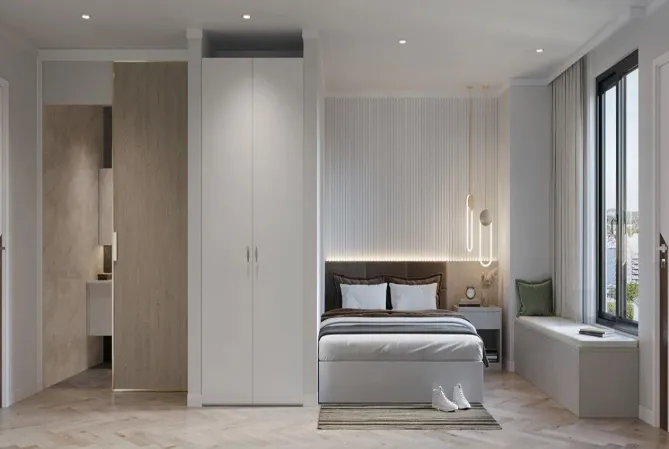
When you’re dealing with a small bedroom, every inch counts. Most people obsess over bed size, nightstand dimensions, and wardrobe depth—but completely overlook one of the biggest space-hogging culprits: the door. That standard 32-inch hinged door might not seem like much until you realize it needs nearly 10 square feet of clearance to function properly. In tight quarters, that’s practically a walk-in closet’s worth of space!
Contents
The Door Dilemma in Small Spaces
I’ve been redesigning small urban apartments for over a decade now, and door selection is consistently one of the most overlooked aspects of space optimization. You know what happens? Clients spend thousands on custom furniture and built-ins, only to lose all that carefully planned space to a poorly chosen door swing.
The traditional hinged door creates what designers call a “dead zone”—that quarter-circle area where nothing can be placed because the door needs to swing. In a standard bedroom, this might not matter much. But in spaces under 120 square feet? That dead zone becomes prime real estate you simply can’t afford to waste.
Space-Saving Door Options
Let’s break down the alternatives that can save significant space while still providing the privacy and functionality a bedroom door needs:
Pocket Doors: The Ultimate Space-Savers
Pocket doors slide completely into the wall when open, eliminating the swing space entirely. They’re the holy grail of small space doors for good reason.
Pros:
- Zero footprint when open
- Clean, minimal aesthetic
- Can be as wide as a standard door
Cons:
- Require wall cavity construction
- More expensive to install in existing walls
- Hardware is inside the wall (making repairs trickier)
I find that pocket doors work best when planned during initial construction or major renovations. Retrofitting them can be costly if electrical wiring or plumbing runs through the wall where the pocket would go.
Barn Doors: Sliding Beauty
Barn doors slide along a track mounted outside the wall, overlapping the wall when open.
Pros:
- Visually striking design element
- Easier to install in existing spaces
- No wall cavity required
Cons:
- Require wall space adjacent to the opening
- Don’t seal as tightly as hinged doors
- Can feel less private (sound transmission)
Barn doors have become incredibly popular, and for good reason—they’re functional and decorative. But be honest about your privacy needs. If you’re using them for a primary bedroom and you’re sensitive to noise, they might not be ideal.
Bifold Doors: The Compromise Solution
Bifold doors fold in on themselves, requiring about half the swing space of a traditional door.
Pros:
- More affordable than pocket or barn doors
- Easy to retrofit
- Better sound insulation than barn doors
Cons:
- Still require some swing clearance
- Multiple hinges can mean more potential failure points
- Can feel less substantial than solid doors
French Doors or Double Doors: Unexpected Space-Savers
This might seem counterintuitive, but in some layouts, using two narrower doors instead of one wide door can actually save space.
Pros:
- Each door requires less swing depth
- Can open just one side when needed
- Elegant, high-end appearance
Cons:
- Require more hardware
- Center mullion reduces clear opening width
- More expensive than single doors
OPPEIN, one of the more innovative door manufacturers I’ve worked with, offers an interesting hybrid solution—French doors where one side remains fixed while the other operates like a standard door. This gives the aesthetic of French doors with the practicality of a single door when that’s all you need.
Material Considerations for Small Spaces
Door material affects not just appearance but also how the door functions in tight spaces:
Glass and Translucent Options
Glass or partially glazed doors allow light to flow between spaces, making small rooms feel more connected and less claustrophobic.
Frosted or textured glass provides privacy while still transmitting light. This can be particularly effective for bedrooms that don’t have windows or have limited natural light.
Lightweight Materials
Solid wood doors are beautiful but heavy. In small spaces, lighter materials can be more practical:
- Hollow core doors are significantly lighter, making them easier to operate in tight spaces
- Composite materials offer durability with less weight
- Aluminum frames with panel inserts provide strength without the heft
By the way, the term “stile and rail” refers to the frame components of a door (stiles are vertical, rails are horizontal), while panels fit within this frame. Understanding this construction can help you choose doors with proportions that work visually in smaller spaces.
Hardware That Makes a Difference
In small spaces, door hardware isn’t just decorative—it’s functional problem-solving:
Space-Saving Handles and Knobs
Protruding handles can be yet another obstacle in tight quarters. Consider:
- Flush pulls or recessed handles
- Magnetic push-latch systems that eliminate handles entirely
- Low-profile lever handles instead of knobs
Specialized Hinges
Several types of specialized hinges can reduce the swing space needed:
- Offset hinges move the door completely outside the frame when open
- Pivot hinges allow doors to swing in both directions
- Continuous hinges (also called piano hinges) distribute weight evenly, allowing for smoother operation of lightweight doors
Color and Visual Weight
The appearance of your door affects how it functions visually in a small space:
Door Color Strategy
- Painting the door the same color as the walls makes it recede visually
- Using a contrasting color creates a focal point (which can work if the door itself is attractive)
- Glossy finishes reflect light, potentially making the space feel larger
Visual Weight Considerations
Some doors simply “feel” heavier than others, even when they’re not:
- Doors with large, unbroken panels appear more substantial
- Multiple small panels or details create visual busyness
- Glass or translucent sections lighten the visual impact
In my experience, the most successful small-space doors are those that don’t call attention to themselves. They should feel proportional to the room and operate so smoothly that you barely notice them.
Installation Considerations
Even the perfect door can fail if installed improperly. In small spaces, precision becomes even more critical:
Clearances Matter
Standard door clearances might not work in very tight spaces. Consider:
- Reducing standard 2-inch bottom clearance if flooring allows
- Ensuring adequate finger clearance on the latch side
- Accounting for baseboard thickness when measuring swing space
Door Swing Direction
The direction your door swings can make or break a small bedroom layout:
- Doors should generally swing into the room, not the hallway (for fire safety)
- Consider which way makes the room most usable when the door is open
- Think about furniture placement relative to the swing
Real-World Applications
Let me share a quick case study from a recent project. I worked with a client who had a 9×10 foot bedroom in a Brooklyn apartment. The traditional hinged door was making furniture placement nearly impossible. We replaced it with a pocket door, which immediately freed up enough space for a proper dresser—something she’d been living without for years.
The transformation wasn’t just about the extra square footage; it was about how the room felt. Without the door swing interrupting the space, the entire room felt more intentional and less cramped.
Conclusion: The Right Door Makes All the Difference
Choosing the right door for a small bedroom isn’t just about aesthetics or even just about saving space—it’s about making the entire room function better. The door is quite literally the gateway to your personal space, and getting it right sets the tone for everything else.
When every square inch matters, the right door solution can be the difference between a cramped, awkward layout and a small but perfectly functional bedroom. And isn’t that what good design is all about? Not just making spaces look good, but making them work beautifully for the people who use them every day.