

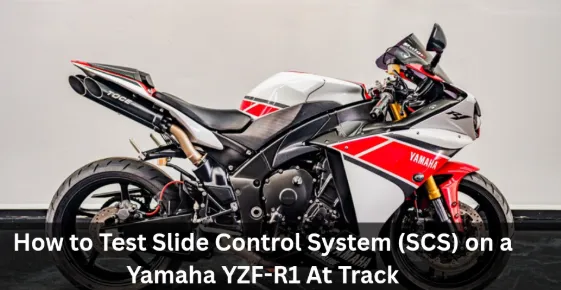
If you ride Yamaha motorcycles and you’ve ever wondered what separates the YZF-R1 from “just another liter bike,” the answer becomes crystal clear the first time you properly use the Slide Control System (SCS) on track.
This is a serious racing aid born directly from Yamaha’s MotoGP program, and when you understand how to test it correctly, it can completely change how confident and fast you are on corner exits.
Let’s walk through this like a rider in my pit garage.
Contents
What Yamaha’s Slide Control System Actually Does
On 2015-plus R1 and R1M models, SCS is powered by a 6-axis IMU that constantly measures lean angle, pitch, roll, yaw, and acceleration.
Instead of just cutting power when the rear tire spins (like basic traction control), SCS allows the rear tire to slide, then manages that slide.
It is a smart riding partner. You pin the throttle mid-corner, the rear steps out, and instead of snapping or highsiding, the bike gently reins it in. It overrides standard TCS logic during acceleration and focuses specifically on controlled rear-wheel drift.
SCS has three levels:
- Level 1: Maximum slide freedom (race mode)
- Level 2: Balanced slide control (best for most track riders)
- Level 3: Conservative intervention (safety-focused)
Before You Roll Onto the Track: Proper Setup Matters
This part is non-negotiable. I don’t care how skilled you are. But a bad setup ruins SCS testing. So, I would suggest the following steps to be done.
- Access the YRC Menu
You can do this via the dash or Yamaha’s Y-Connect app.
Set it up like this:
- Power Mode: Mode 1 (full power)
- Traction Control (TCS): Off or Level 1
- Slide Control (SCS): Start at Level 2
- Engine Brake Management (EBM): Level 2 or 3
- Lift Control (LIF): Off
- Quickshifter (QSS): On (up and down)
This configuration gives SCS room to work without other systems stepping on it.
- Tires Are Everything
If you’re serious about this, you need:
- Slicks or top-tier hypersport tires (RS11, Supercorsa, etc.)
- Fully warmed tires, over 100°F minimum, ideally 140–160°F
Cold tires turn “controlled slide” into “unplanned rodeo.” No exceptions.
Session 1: Get Familiar (Don’t Be a Hero)
Start slow and methodical. Pick a medium-radius corner, something in the 60–90° range with a clean exit.
Here’s the process:
- Brake hard and trail into the corner
- Downshift using the auto-blipper
- Hit the apex cleanly
- At around 50–60% lean, commit to the throttle
Yes, commit. Hesitation confuses the system.
What you should feel: The rear tire steps out about 5–10 degrees. Power gets trimmed smoothly. The bike stays calm. No snap. No panic. It feels like the bike is helping you slide, not fighting you.
If you roll off the throttle slightly, the bike immediately straightens up. That’s SCS doing its job.
Session 2: Compare SCS Levels Like a Pro
Once you trust the system, it’s time to experiment.
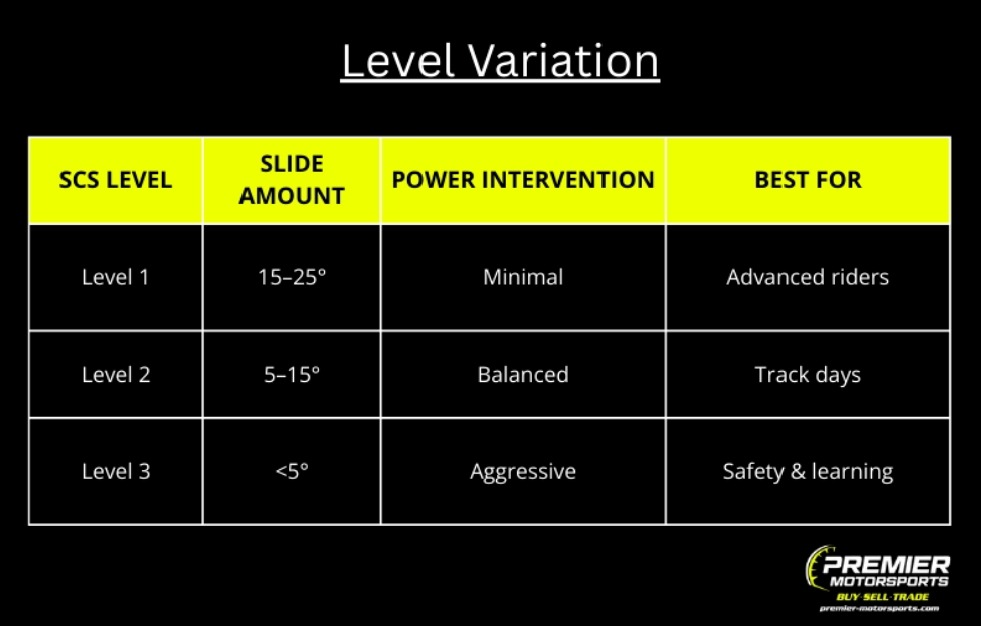
Run 3–5 laps per level. Pay attention to:
- Exit stability
- Throttle confidence
- Lap time consistency
Most intermediate and advanced riders are fastest on Level 1 or 2, especially once tires are fully hot.
Session 3: High-Speed Exit Validation
Now we stress-test the system. Choose a fast corner with a 120+ mph exit. As you pick up the bike, go wide open throttle.
And this is what you’ll feel:
- Rear tire drifting slightly
- Minimal speed loss
- No violent corrections
If you have data logging enabled, review:
- Lean angle
- Slide rate
- Throttle cut timing
How to Tell SCS Is Working Correctly?
You’ll know it’s right when:
- Power modulation feels smooth, never jerky
- The rear slides progressively, not suddenly
- The SCS indicator flashes during exits
- Behavior is consistent at different lean angles
If the bike feels unpredictable, check tire temps and make sure your IMU sensors are clean. Dirt or debris can cause erratic behavior.
Safety Tips From Experience
A few hard-earned lessons:
- Don’t disable TCS completely until you understand SCS behavior
- Always do 5–10 warm-up laps
- Cold tires cause snap slides—period
- The R1M’s Öhlins suspension gives clearer feedback, but the base R1 works brilliantly too
One of the biggest mistakes I see is riders trying to force slides before the bike and tires are ready. Let the system work with you.
Why This Matters for Real-World Riders
Mastering SCS isn’t about looking flashy. It’s about:
- Reducing fear at the corner exit
- Improving throttle confidence
- Shaving 1–2 seconds per lap safely
This is exactly why Yamaha motorcycles have such a strong reputation on track. The technology genuinely helps riders go faster, not just survive.
If you’re new to the R1 or want help dialing it in, talk to experienced motorcycle dealers who understand track setups, not just street settings. A knowledgeable dealer can make sure your electronics, suspension, and tires are all working together.
Final Thoughts
Slide Control System is one of Yamaha’s most underrated performance tools. When tested progressively and respectfully, it transforms how the R1 behaves at the limit. You stop fearing rear-wheel spin and start using it.
That’s when the bike stops feeling like a machine and starts feeling like a teammate. Ride smart, trust the tech, and let SCS do what Yamaha built it to do.