

You might be standing in the bathroom, looking at the space where a tooth used to be, and wondering how such a small gap can create so much worry. You may be thinking about your smile, how you chew, or even how this might affect the rest of your teeth in a few years. On top of that, you are probably hearing different opinions about bridges, partial dentures, and implants, and it can feel like one more hard decision in a life that already has enough of them—especially when you’re trying to decide which dentist in Great Falls to trust with your care.
If you are anxious about making the “wrong” choice, that makes sense. Missing a tooth is not just a cosmetic issue. It affects your confidence, your comfort when eating, and the long term health of the teeth that are still there. The short version is this. Dental implants often do more than fill the gap. They can help protect the neighboring teeth in a way that other options cannot.
So where does that leave you when you are trying to decide what to do next?
What really happens to your other teeth when one is missing?
When a tooth is lost, it rarely stays as “just a gap.” Teeth are social. They like to lean on each other. Once one is gone, the neighbors tend to move into the empty space. The tooth next to the gap may tilt, the tooth above or below may drift down, and your bite can slowly shift. You may not notice this in a week or even a month, but over time it can change how your teeth fit together.
This movement can create new tight spots that trap food, make cleaning harder, and increase the risk of decay or gum problems around the remaining teeth. You might start to notice more sensitivity, more plaque build up, or even chipping on edges that now take more force than they were designed to handle.
On top of that, the jawbone under the missing tooth no longer gets the same “signal” from chewing. According to the U.S. Food and Drug Administration, dental implants are placed into the jawbone where they fuse with the bone and act like artificial roots, helping support replacement teeth in a stable way. You can see more about how that works in their guidance on what you should know about dental implants. Without that kind of stimulation, the bone in the area can slowly shrink, which may affect how stable the nearby teeth feel.
Because of all this, you might wonder whether doing nothing is really an option, and whether a dental bridge or a partial denture can protect the surrounding teeth in the same way that dental implant treatment can.
Why replacing a missing tooth with an implant can shield the teeth beside it
To understand why tooth implants help adjacent teeth, it helps to compare them with the more traditional bridge. A bridge usually requires the dentist to shape down the two healthy teeth next to the gap so crowns can be placed on them. Those crowns then support a false tooth in the middle. It can look natural, but it means removing healthy tooth structure from neighbors that were not damaged in the first place.
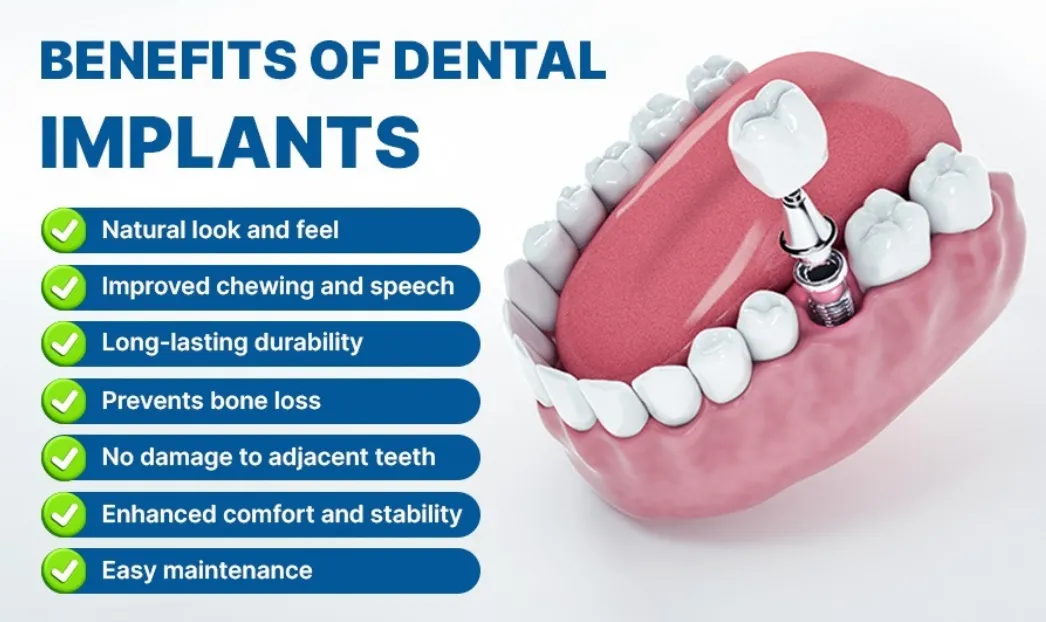
With an implant, the replacement tooth stands on its own. The implant post is placed in the bone where the missing root used to be. The teeth on either side are left untouched. They do not need to be ground down, and they do not carry the extra load of supporting a false tooth. This is one of the main ways implants protect adjacent natural teeth. They avoid unnecessary work on teeth that are still sound.
There is also the question of chewing forces. When you bite, the pressure travels through your teeth into the jawbone. An implant shares this load much like a natural tooth. That helps keep the bite more balanced and can reduce excessive stress on neighboring teeth. If the gap is left empty, those adjacent teeth may take on more force than they should, which can lead to wear, cracks, or discomfort over time.
Bone health matters here as well. Research supported by the National Institute of Dental and Craniofacial Research, which you can see in their recent congressional justification document, continues to highlight the connection between tooth loss, bone changes, and oral function. Because implants stimulate the bone, they can help slow or limit the bone loss that often follows an extraction. When the bone is preserved, the roots of the nearby teeth remain better supported.
So the protection is not only about today. It is about keeping your remaining teeth strong, supported, and as untouched as possible in the years ahead.
How do implants compare with doing nothing or choosing a bridge?
It can help to see the differences laid out. Imagine three paths. You leave the space alone. You choose a traditional bridge. Or you choose an implant supported single tooth. Each option has tradeoffs that affect the teeth next to the gap.
| Option | Impact on Adjacent Teeth | Bone Support Under Gap | Oral Hygiene |
| Do nothing (leave gap) | Teeth may drift or tilt into space. Bite can shift. Food traps often increase. | Bone usually shrinks over time. Support for nearby roots may lessen. | Harder to clean tilting teeth and deepening spaces around them. |
| Traditional bridge | Requires reshaping adjacent teeth for crowns. Extra load on those teeth. | Bone under missing tooth is not directly stimulated and may still shrink. | Flossing requires special tools under the bridge. Plaque can collect at edges. |
| Single dental implant | Adjacent teeth stay untouched. Forces shared more evenly across the bite. | Implant helps stimulate and maintain bone where the tooth was lost. | You can usually brush and floss much like a natural tooth. |
Published research on single tooth implant outcomes also supports this picture. Many studies report high long term survival rates and good stability of the tissues around implants when they are properly planned and cared for. That stability is part of what helps protect neighboring teeth from shifting or losing support.
So when you weigh your options, it is not only about what fills the gap fastest. It is about which approach respects and preserves the teeth you still have.
Three practical steps you can take right now
1. Get a full mouth evaluation, not just a “tooth check”
Ask for a complete exam that looks at your bite, gum health, and bone levels, not only the missing tooth. This may include X rays or 3D imaging. The goal is to understand how the gap is affecting the rest of your mouth, and whether nearby teeth are already shifting or showing extra wear.
2. Ask your general and implant dentist to walk you through scenarios
When you talk with a general and implant dentist, ask them to compare “implant vs bridge vs leaving the space” for your specific case. Ask questions like. Which teeth would need to be drilled for a bridge. How might my bite change if I do nothing. How will each choice affect the long term health of my other teeth. You deserve to see the short and long term picture, not just the upfront cost.
3. Protect your existing teeth while you decide
Even if you are not ready to choose a treatment today, you can protect your adjacent teeth by keeping the area as clean as possible. Use careful brushing, flossing, and, if your dentist recommends it, small interdental brushes around the neighboring teeth. If your dentist suggests a temporary solution to keep teeth from drifting, such as a simple removable appliance, consider using it while you plan a more permanent option.
Moving forward with more clarity and less fear
You might still feel nervous about surgery, cost, or recovery. That is human. What matters is that you now understand that replacing a missing tooth is not only about your smile in photos. It is about protecting the teeth you still have, keeping them strong, and avoiding extra treatment on them later.
When you speak with your dentist, bring your questions, your worries, and your priorities. A thoughtful plan for dental implant care can give you more than a new tooth. It can give your remaining teeth a better chance to stay healthy and untouched for years to come.